The brief was a school finder. What parents actually needed was a companion, covering pregnancy through formal education. We reframed it, won the pitch, and delivered across three platforms in fourteen weeks.
Client
Abu Dhabi Department of Education and Knowledge (ADEK)
Deliverable
iOS, iPadOS and Android app
Timeline
August 2022. 14-week design phase
Role
Experience strategy, pitch lead, UX Director through to dev handoff
Team
Service designer, interaction designer, visual designer, UX writer, DXP consultant
80%
of parents used the platform weekly, with high satisfaction rates
76%
felt more equipped to support their children, citing the academic tracker
1,200+
parents joined community support forums in the first three months
01 / Overview
A reasonable brief, and a much more ambitious answer.
When ADEK approached us, they had a reasonable brief: build a functional digital platform to help Abu Dhabi parents navigate the school system. What they got was something far more ambitious.
I led the pitch, won the business, and then led the team that delivered it. Over 14 weeks we designed a full-stack parenting companion for iOS, iPadOS, and Android that covered everything from pregnancy through to a child's formal education. The platform, named Rayah, launched successfully and changed how ADEK engaged with families across the emirate.
This is a case study about what happens when you use design strategy to reframe the brief, persuade a government client to think bigger, and then actually deliver on that promise.
02 / The challenge
The brief was to build a tool. What parents needed was a companion.
The original ask was fairly narrow: help parents with educational services. School finder, enrolment information, a few ADEK resources. Functional. Useful. Forgettable.
The real problem was more interesting. Parents in Abu Dhabi were navigating an incredibly complex environment. The UAE has one of the most diverse populations in the world. Emiratis managing the intersection of cultural identity and modern education. Expats relocating mid-school year with no local network. Parents of children with additional needs finding fragmented and often inaccessible support.
What united them was the same underlying need: they wanted to feel less alone in it.
There were real constraints too. ADEK's services spanned multiple government systems. The audience was trilingual. The platform had to work for a first-time Emirati mother tracking her newborn's development and for an expat family arriving from Singapore needing to compare nurseries by the weekend. All of it inside a 14-week design phase, with a government client and a technical DXP handoff at the end.
03 / Process
Winning the pitch was itself a design exercise.
Before any design work started, I led the pitch team. We had to show ADEK that their brief was underselling what was possible, without making them feel like we had ignored it. We came in with a reframe, from a service directory to a parenting companion, backed by user-need evidence and a clear MVP phasing plan that would prove value fast before scaling ambition.
We won the business.
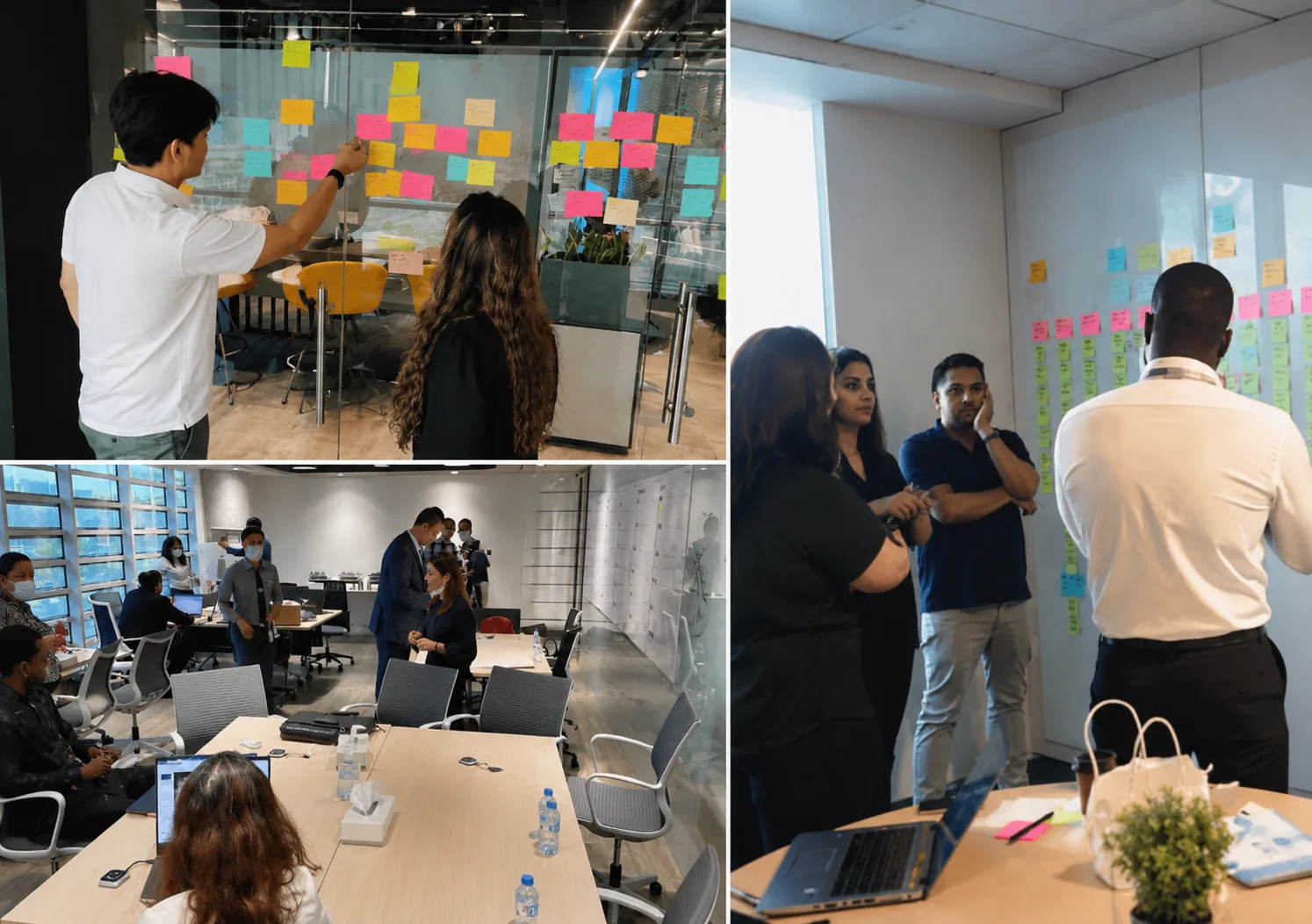
Discovery and definition workshops, Abu Dhabi. Stakeholder interviews, journey mapping and dotmocracy, run with the ADEK team in the room rather than presented back to them.
Reframing the brief: features versus goals
The first thing we had to do internally was resist the pull of the feature list. ADEK had a long wishlist. Curriculum Advisor, School Finder, Enrolment Management, Broadcast Messages, Budget Planner, Child Development Tracker, Discussion Forums. All valid. None of them, on their own, answered the real question: what is Rayah actually for?
Rayah should inform, guide, and enable any parent looking for support from ADEK's resources, so they can become more empowered, educated, and empathetic caregivers.
The positioning line that drove every prioritisation decision that followed
Discovery: understanding who we were designing for
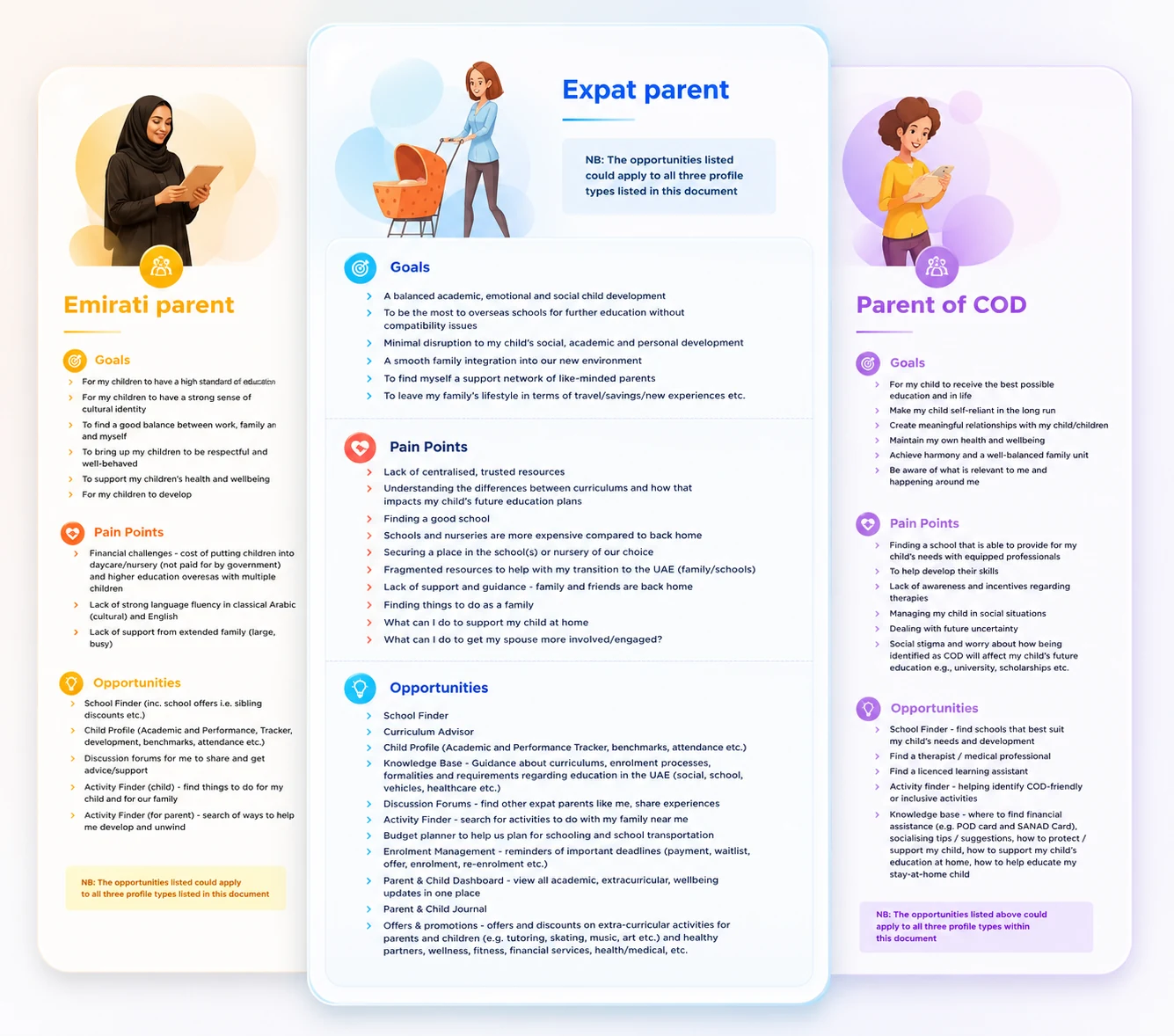
Abu Dhabi's parent population is one of the most diverse in the world. We could not design for a generic parent. A structured discovery phase of workshops, stakeholder interviews, desk research and comparative analysis produced three dominant profiles, used throughout as a decision-making tool rather than decoration.
Profile 01
The Emirati parent
Balancing cultural identity, high educational standards, and a school system changing rapidly. Pain points: curriculum fit, new government policy, no centralised resource. Strong community ties, limited digital touchpoints with ADEK.
Profile 02
The expat parent
Often arriving mid-year with no local network. School waitlists, curriculum compatibility, cost pressure, and continuity across relocations. Highly motivated, highly anxious, dramatically underserved.
Profile 03
Parent of a Child of Determination
Managing a system improving but still fragmented. Finding the right school, therapist, financial support and community meant multiple platforms, multiple calls, frequent dead ends. The most acute need, and the most to gain.
The three parent profiles as issued to the client team, with goals, pain points and platform opportunities for each. Used to settle scope arguments, not to decorate a deck.
Journey mapping: finding the emotional thread
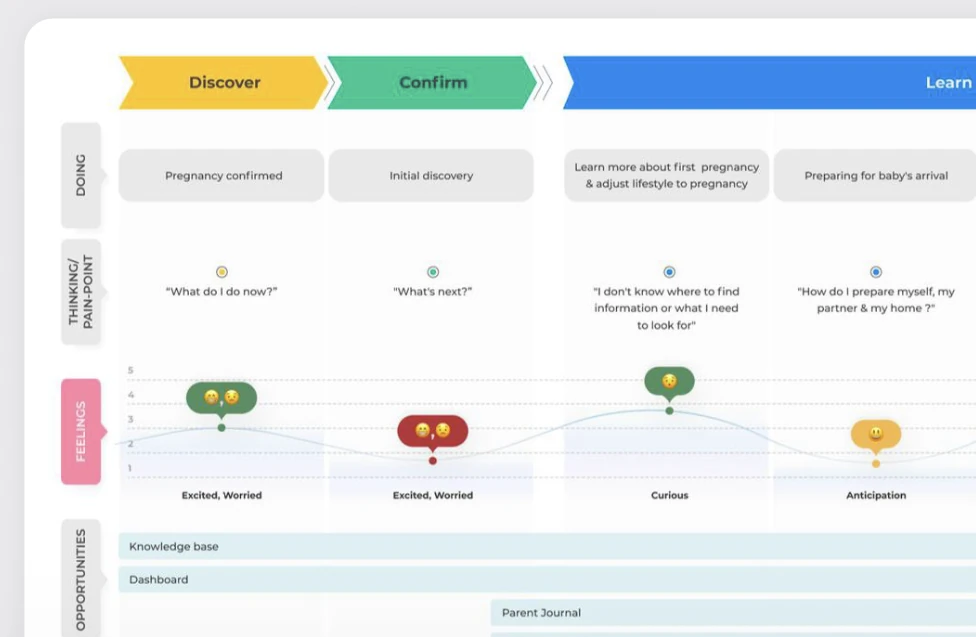
We mapped the parent journey from pregnancy confirmation through to a child entering formal education. Not only as a UX exercise, but as a way to build empathy with the ADEK client team.
Mapping emotions alongside actions revealed something important. The moments where parents felt most anxious and most underserved were not the complex bureaucratic tasks. They were the quiet, uncertain ones.
"What do I do now?" "Am I ready?" "How do I find my tribe in this city?"
No government service had ever tried to address those moments. Rayah could.
The parent journey from pregnancy confirmation to formal education. Actions along the top, emotional state plotted beneath. The dips are where the platform had most to offer.
That insight directly shaped the platform's content strategy, its community features, and the proactive notification architecture.
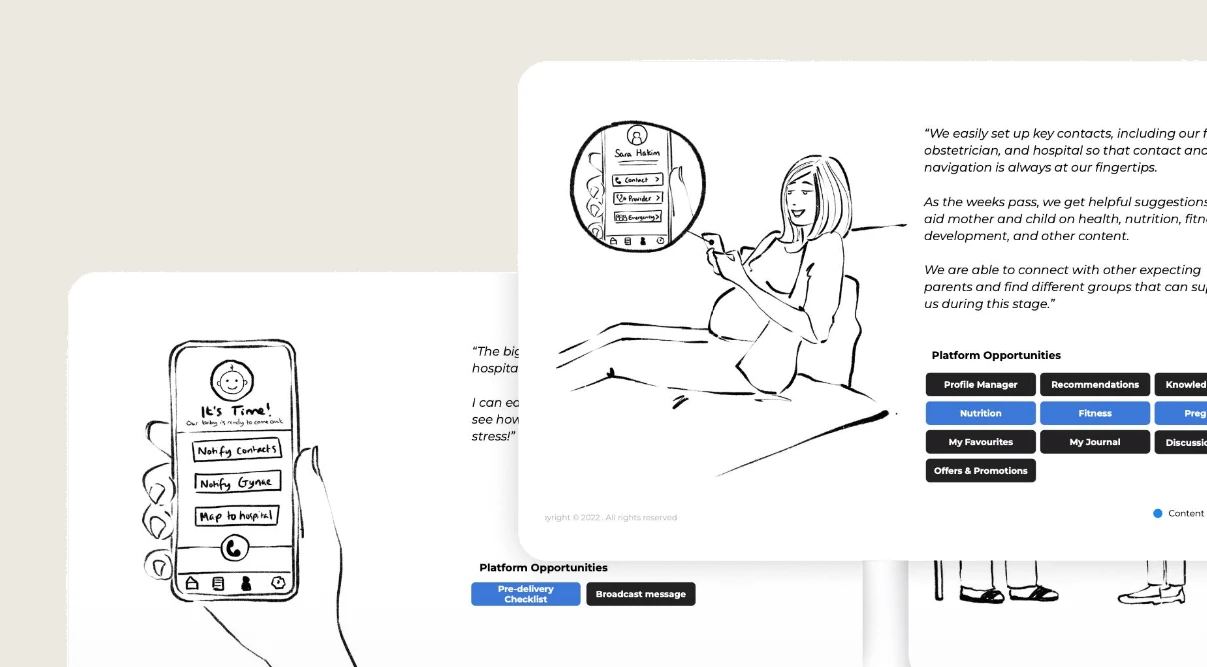
Scenario sketches. Each moment in the journey was drawn out and tested against candidate features before any interface existed. Cheap to draw, cheap to throw away.
Definition: from opportunities to priorities
We took ADEK stakeholders through the experience map stage by stage in structured definition workshops. Each journey stage generated opportunities: insights, implications, and early feature recommendations synthesised from research. Co-creation sessions and dotmocracy turned those into a workable roadmap.
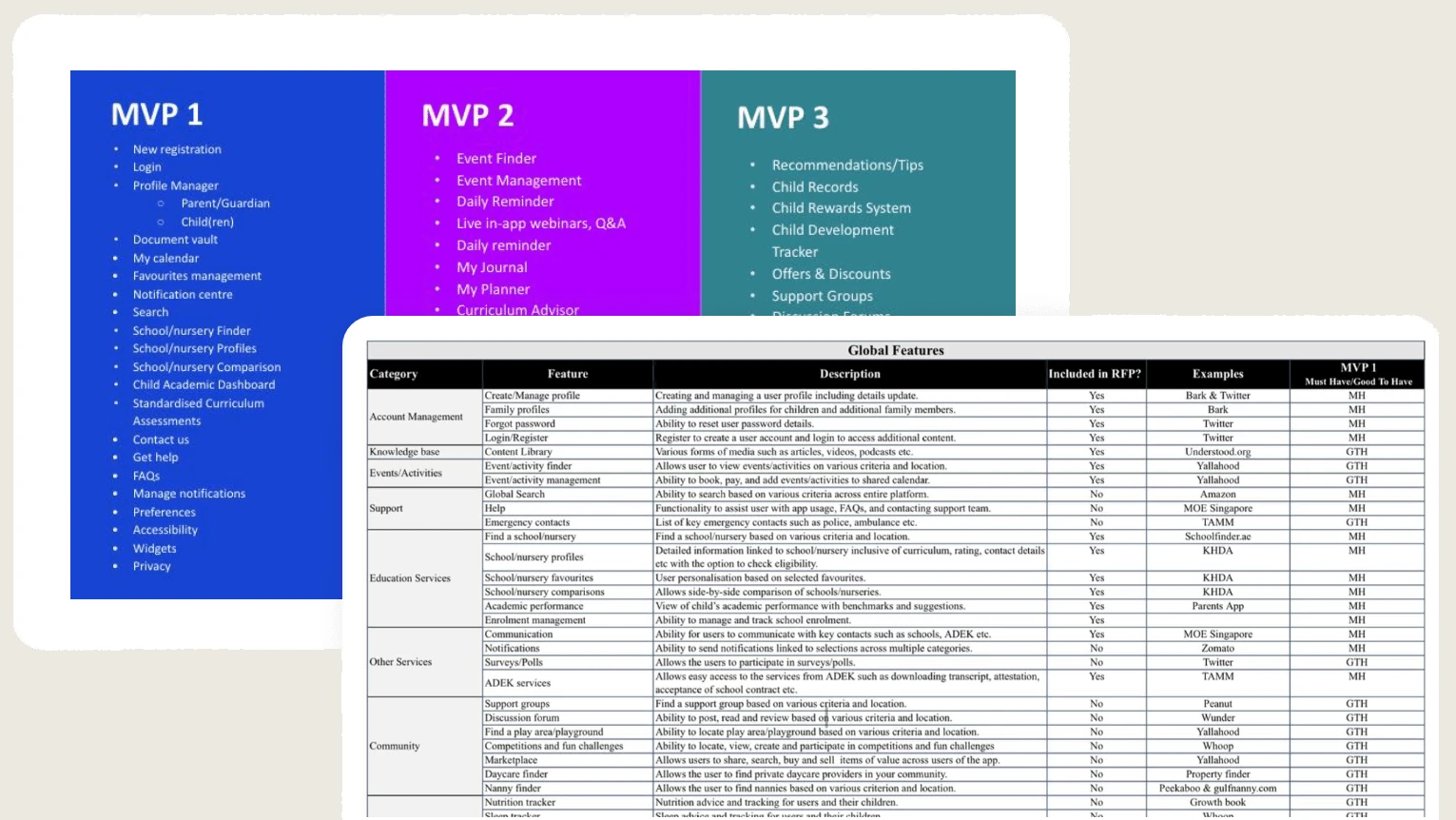
Community features, My Journal, My Planner, event finder, live Q&A with experts, daily reminders.
MVP 3 Advocacy
Long-term engagement
Child rewards system, personalised recommendations, discussion forums, child development tracker, offers and discounts.
MVP phasing agreed in co-creation, and the global feature matrix behind it, where every candidate feature was scored must-have or good-to-have against the RFP.
Design: multi-platform, multi-persona, 14 weeks
The design phase ran across weeks 7 to 12, simultaneously for iOS, iPadOS, and Android, across a feature set that had to serve three very different parent profiles without feeling designed by committee. Four decisions shaped the outcome.
Profile-first architecture. The platform organises itself around the parent and child profile. Once ADEK knows who you are, the experience adapts. Curriculum information relevant to your child's age, schools by location and preference, deadlines that matter to you. The profile is not a settings page; it is the engine of personalisation.
Proactive over reactive. Parents should not have to know what to search for. Rayah tells them what is coming, what is relevant, and what they might have missed. This shaped the home dashboard, the notification framework, and the content strategy.
Community as a core feature, not a bolt-on. Government platforms tend to be cautious about user-generated content. We made the case that the absence of community was itself a risk: parents would find their community elsewhere and ADEK would lose the relationship. They agreed.
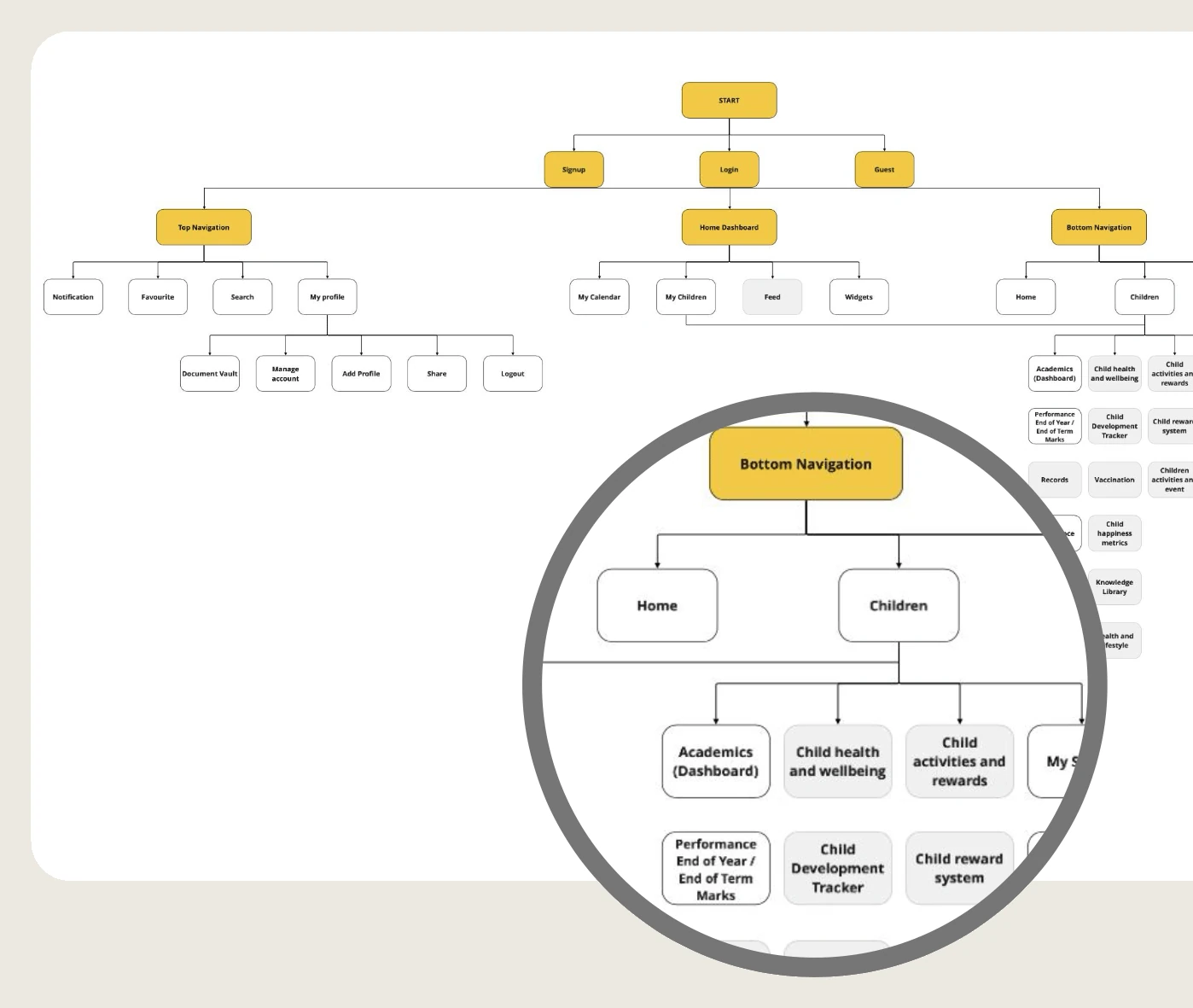
Sitemap as a stakeholder alignment tool. A full sitemap across all sections, presented before high-fidelity design, saved weeks of scope ambiguity later.
The full platform sitemap. Signed off before a single high-fidelity screen was drawn.
We delivered full high-fidelity prototypes for web and app, finalised all key templates ready for development, and completed user stories for all MVP features inside the 14-week window.
04 / The solution
One coherent profile, three very different lives.
Rayah launched as a comprehensive digital companion for parents across Abu Dhabi, covering the full parenting journey from pregnancy through formal education.
For the Emirati parent: a school finder built around Abu Dhabi's curriculum landscape, with comparison tools, school profiles with community ratings, and a child academic dashboard integrated with ADEK's performance data. Cultural context baked in, not bolted on.
For the expat parent: an onboarding experience designed to orient a family arriving in a new city: waitlist management, area-based nursery search, curriculum comparison, and a community connecting them with parents who have made the same transition.
For the parent of a Child of Determination: accessible design throughout, a dedicated resource pathway covering therapists, learning assistants and COD-specific support, financial assistance guidance (POD card, SANAD), and community groups that reduce isolation.
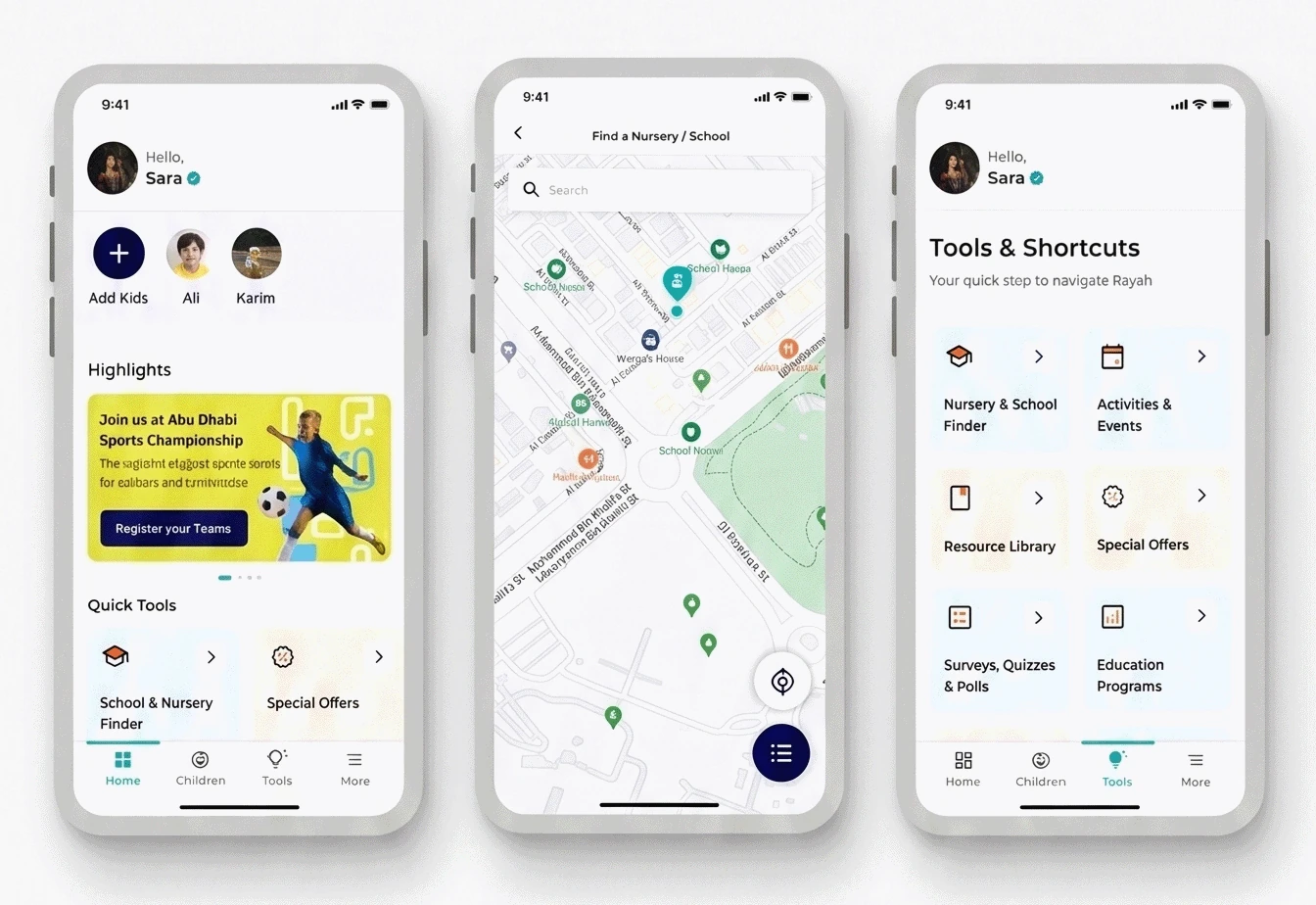
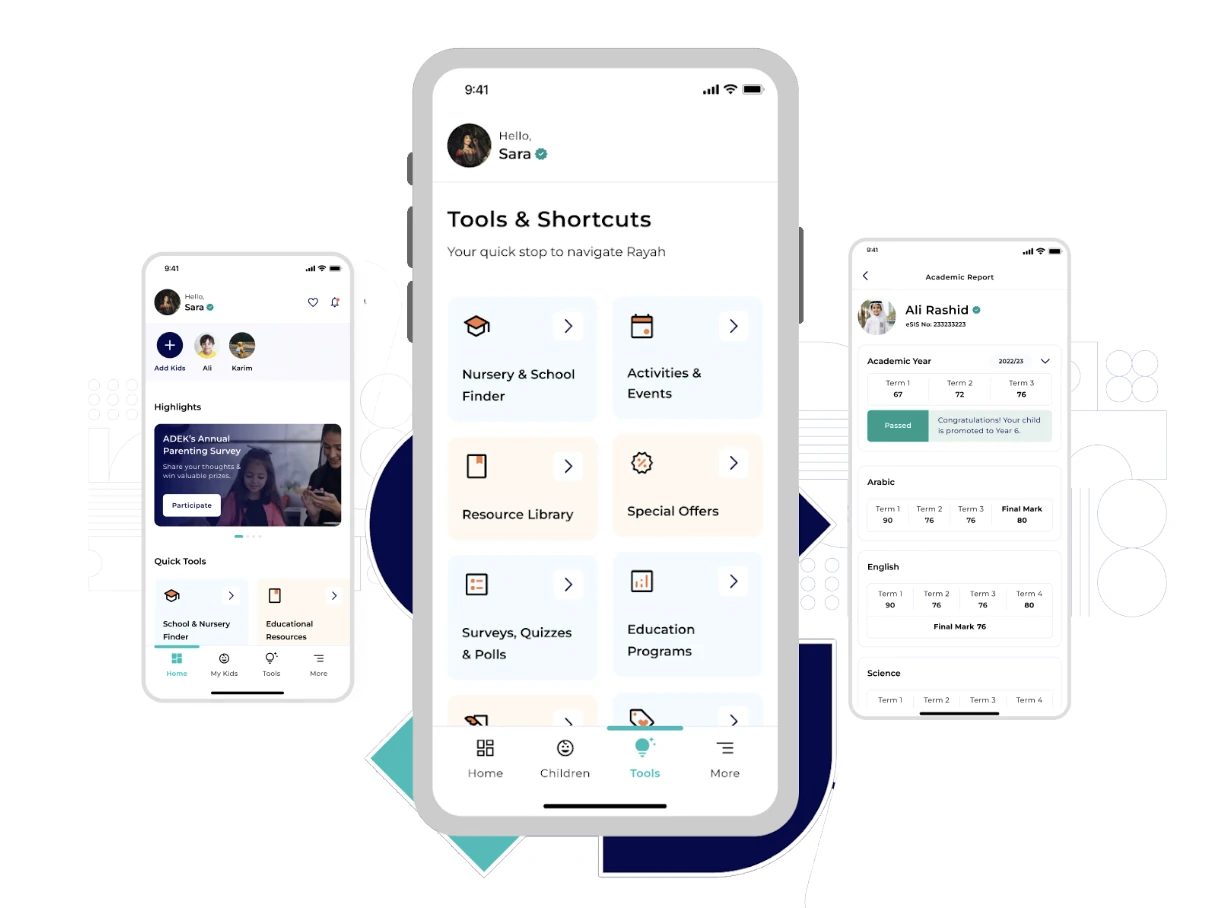
As shipped: home, the nursery and school finder, and the tools index.Tools & Shortcuts, the multi-child parent dashboard, and a child's termly academic report.
Platform-wide: a proactive notification architecture surfacing the right information at the right moment. A journal. A budget planner. A curriculum advisor. An emergency broadcast feature. All organised around a single, coherent parent profile, delivered across iOS, iPadOS and Android with a fully documented design system and handoff package.
05 / Impact
From a regulatory presence to a supportive one.
80%of parents used the platform weekly, with high satisfaction rates
76%felt more equipped to support their children
1,200+joined community forums in the first three months
High satisfaction scores across the parent journey, particularly for the school finder and content library.
Beyond the metrics, the platform shifted something more fundamental. ADEK moved from being a regulatory presence in parents' lives to being a supportive one. That is a reputational and relational shift no single feature could have achieved. It required getting the whole experience right.
06 / Reflection
The scope of a brief is itself a design problem.
The decision to reframe the brief was the most important design decision on this project. It was also the riskiest. Government clients often have internal alignment around a specific scope, and challenging that scope in a pitch can feel presumptuous. We made the call anyway because the research was clear: the narrow brief would have produced a useful tool that parents might visit occasionally. The bigger brief produced something they would actually come back to.
That required a different kind of design leadership. Less directing a team through a process, more earning the trust of senior ADEK stakeholders, managing expectations across a 14-week crunch, and making sure the team had the space to do their best work.
If I were doing this again, I would push harder on the MVP 2 community features at launch. The 1,200+ forum sign-ups in three months suggest we underestimated how much parents wanted that connection. Getting community into MVP 1 would have changed the launch story. I would also start the DXP technical alignment earlier; the handoff was smooth, but some of the more ambitious personalisation features required back-and-forth that could have been compressed.
The best design directors do not just solve the problem they are given. They work out which problem is actually worth solving.
Project delivered at BrainLake Digital (PwC Partner Agency), 2022. Case study by Imran Abbasi.