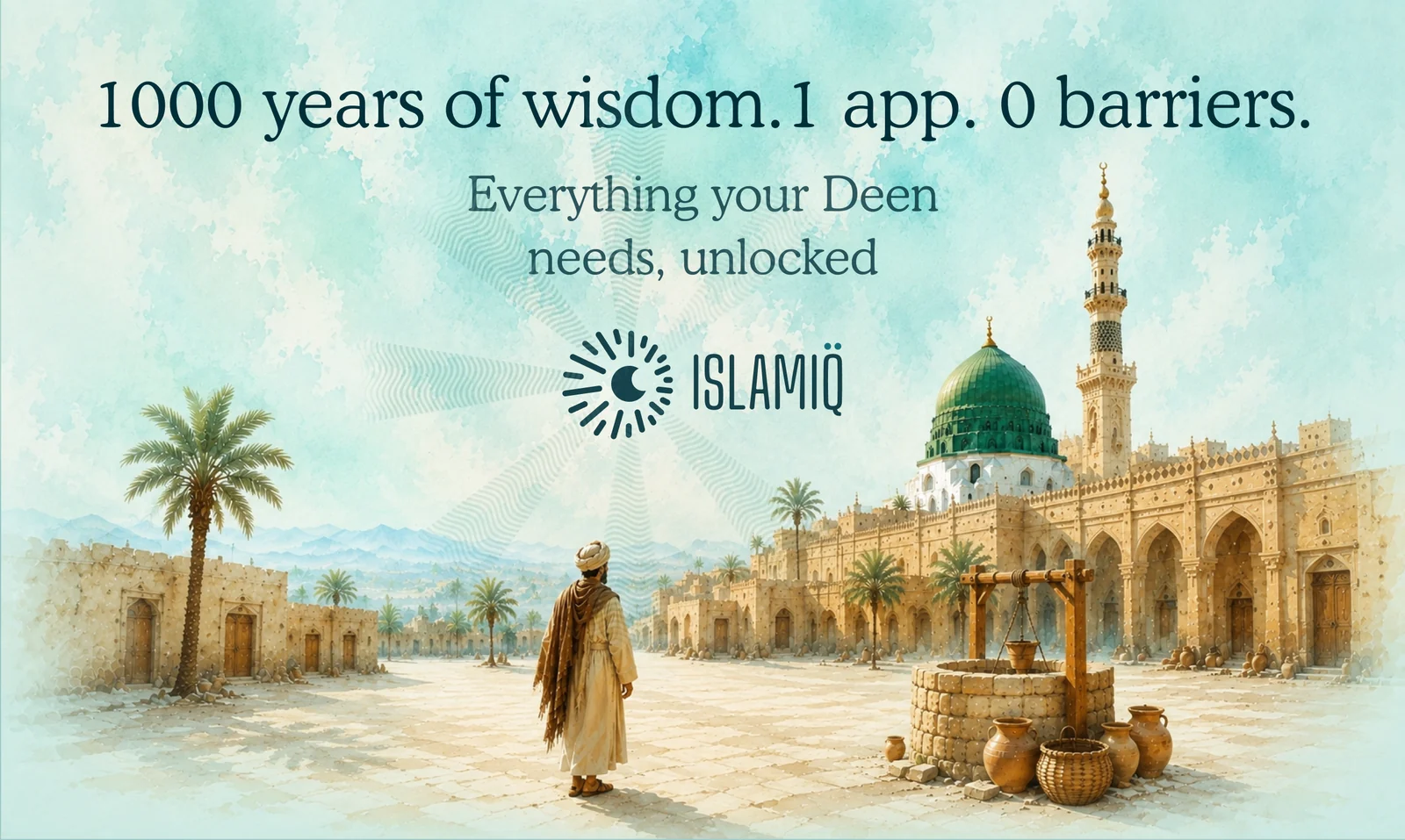
Faith deserves better than what it had.
Islamic apps had become relics. Cluttered interfaces, sources you could not verify, features piled on without thought. Two failures running at once: the design was poor, and the answers could not be trusted.
The obvious move was to add AI. That makes the second failure worse. A general-purpose model answers a question about religious obligation with the same fluent confidence it brings to a recipe, and it is wrong in ways the person asking has no way to detect.
The danger was never a wrong answer. It was a confident one.
So we built the product in layers, and each layer had to earn the right to exist before the next one was allowed.
Before anything else, the retrieval had to be right.
Hundreds of classical works, several never previously translated, ingested and indexed so that every answer traces back to a named book by a named scholar.
The hard part is not ingestion. It is retrieval that stays honest under load. Vector search systems drop chunks, and the failure is silent. The answer still reads as complete; it is missing the passage that would have changed it. A retrieval bug in most products means a worse result. Here it means the app quotes the tradition inaccurately, which is the one thing it cannot do.
So the ingestion pipeline was built around chunk integrity rather than speed: translation optimised for retrieval rather than literature, keeping the Arabic terms people actually search for, and citations attached at the chunk level rather than reconstructed afterwards.
Not Wikipedia. Not ChatGPT. Better.
The claim we had to build the infrastructure to deserveEvery answer surfaces the book and the scholar it came from, and the reader controls the sources: Quran, Hadith, scholars, or all three. Citations you can check yourself is the whole proposition. Without it, this is another chatbot with a crescent on the icon.
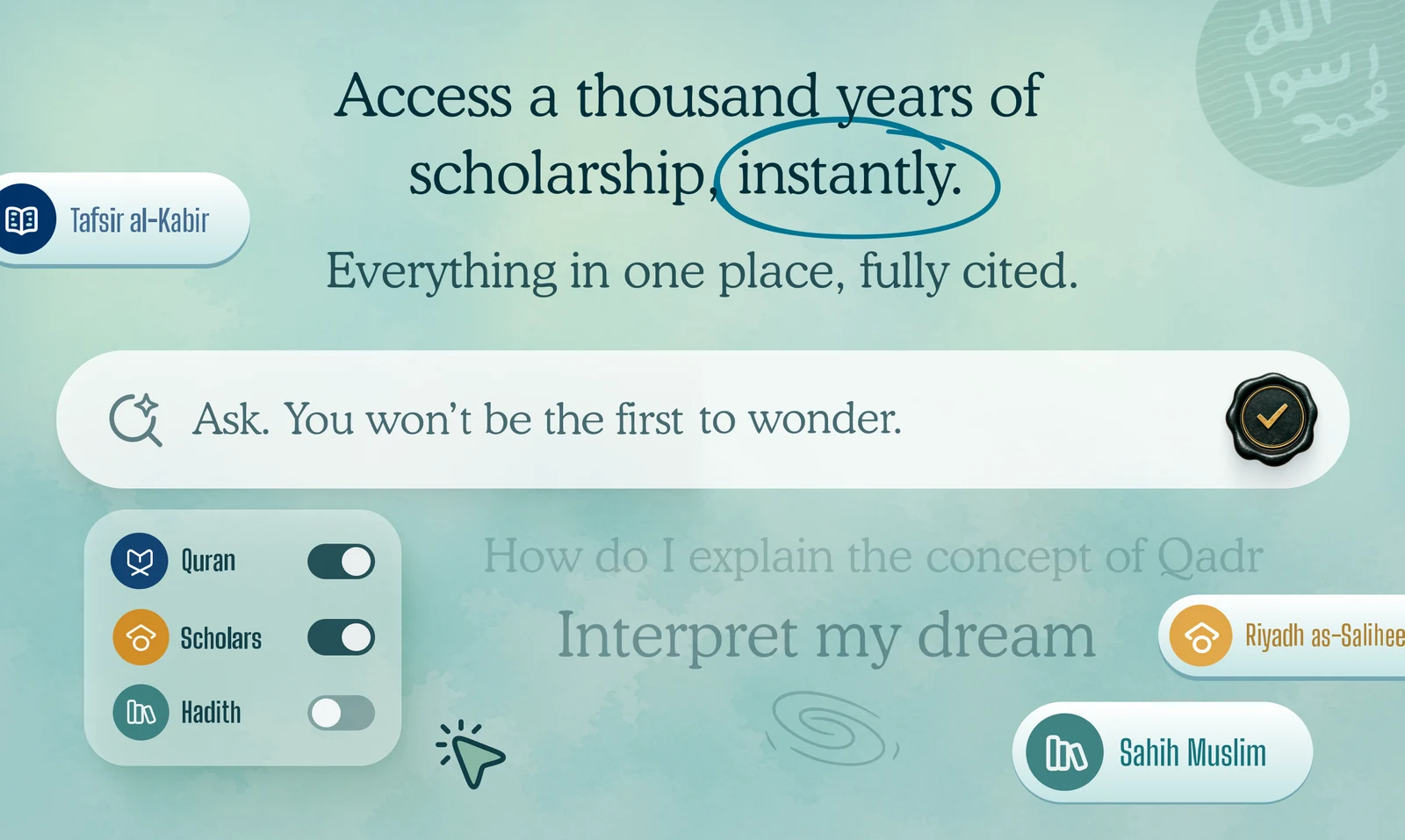
Then: conversation with the people who wrote them.
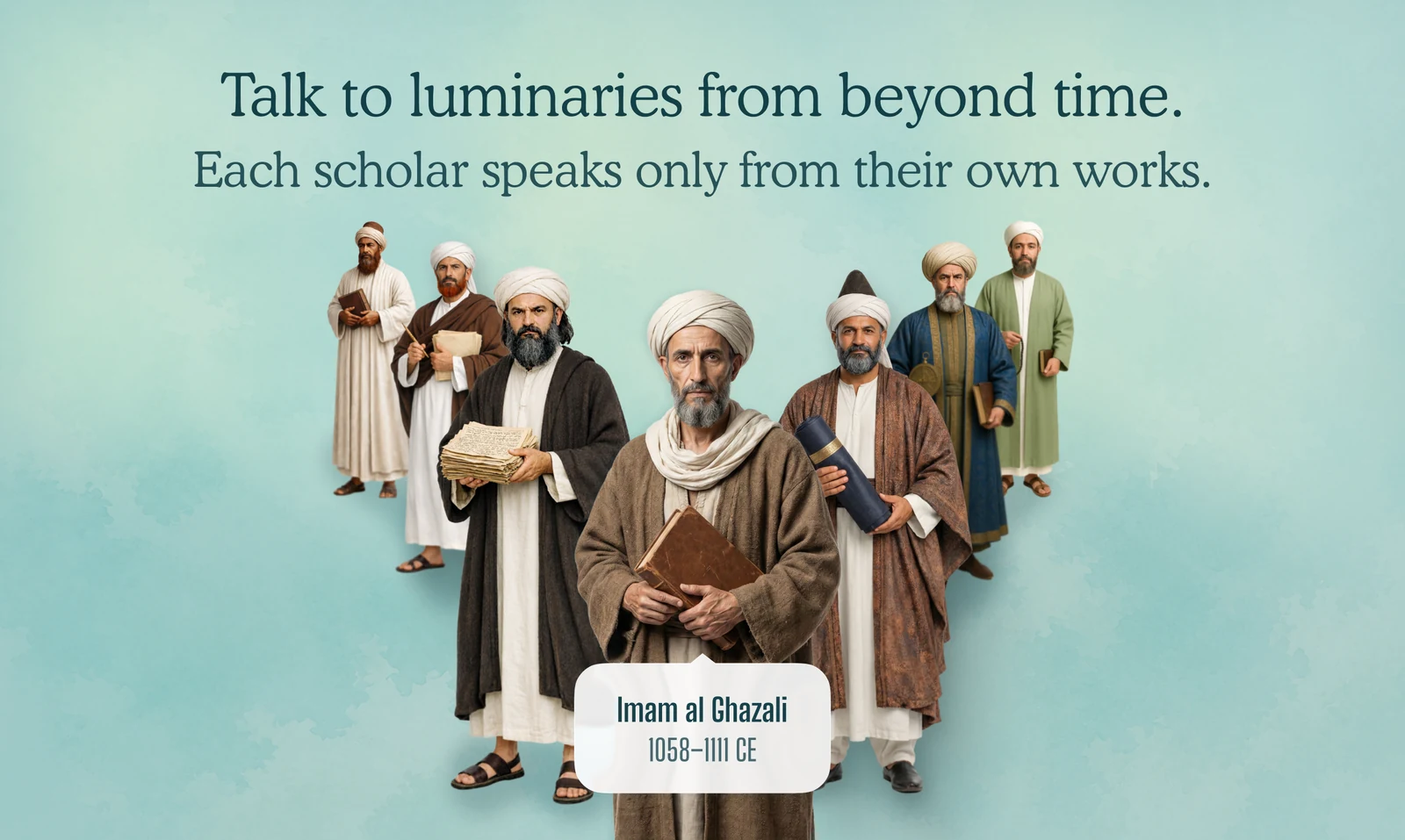
With grounded retrieval working, something became possible that had not been before. If the system can reliably fetch what a specific scholar wrote in a specific book, a person can put a question to that scholar and get an answer built only from his own words.
Al-Ghazali answers from the Ihya. Ibn Taymiyyah from the Fatawa. Ibn al-Qayyim from the Madarij. No blending of voices, no filling a gap with something that sounds right.
The constraint is enforced in the architecture, not requested in a prompt. A guard prevents the model importing debates it knows from training but that are absent from the sourced text. Those debates are real. Using them would be inventing evidence.
Each scholar speaks only from their own works. No mixing. No guessing.
A search box only helps people who already have the question.
Two features in and the product served the curious and the studious. It did nothing for the much larger group who know something is missing but could not tell you what to type.
The library was open and going unread. A twenty-two-year-old does not read a fourteenth-century treatise on the diseases of the heart because it is now available in English. We had made the knowledge accessible and it stayed unopened.
So we brought the knowledge out to meet people: short insights drawn from the classical works, written for a phone screen or a commute. Summaries were the obvious move, and summaries flatten. So instead, four frameworks, each one a genre the tradition had already produced.
The Tension That Built
From usul al-fiqh as a living problem-solving discipline. Tension as generative, ending in something constructed rather than a fight.
The Idea’s Biography
From tarikh al-fikr. The idea is the protagonist; the scholar is a stop on its journey.
The Word Beneath the Word
From tafsir and lugha. What a single term carries, before translation smooths it away.
The Lost Inheritance
From tabaqat and hadara. Pure recovery. The reader draws the contemporary conclusion, which lands harder than being told.
Because each carries authentic intellectual DNA, no one can accuse the product of inventing a format that does not belong to the tradition.
Fifty-one iterations
Making generation reliable took fifty-one iterations of the prompt system. Not drafts of copy: passes over the rules governing what the model may and may not do. Anti-hallucination constraints. The cross-scholar attribution guard. Naming conventions. A ban list for generic openers. A structure contract requiring the original question to be restated, deepened and resolved; if the question disappears mid-piece, the piece has failed.
Fifty-one is not a boast about effort. It is the count of ways we found for the system to quietly say something untrue.
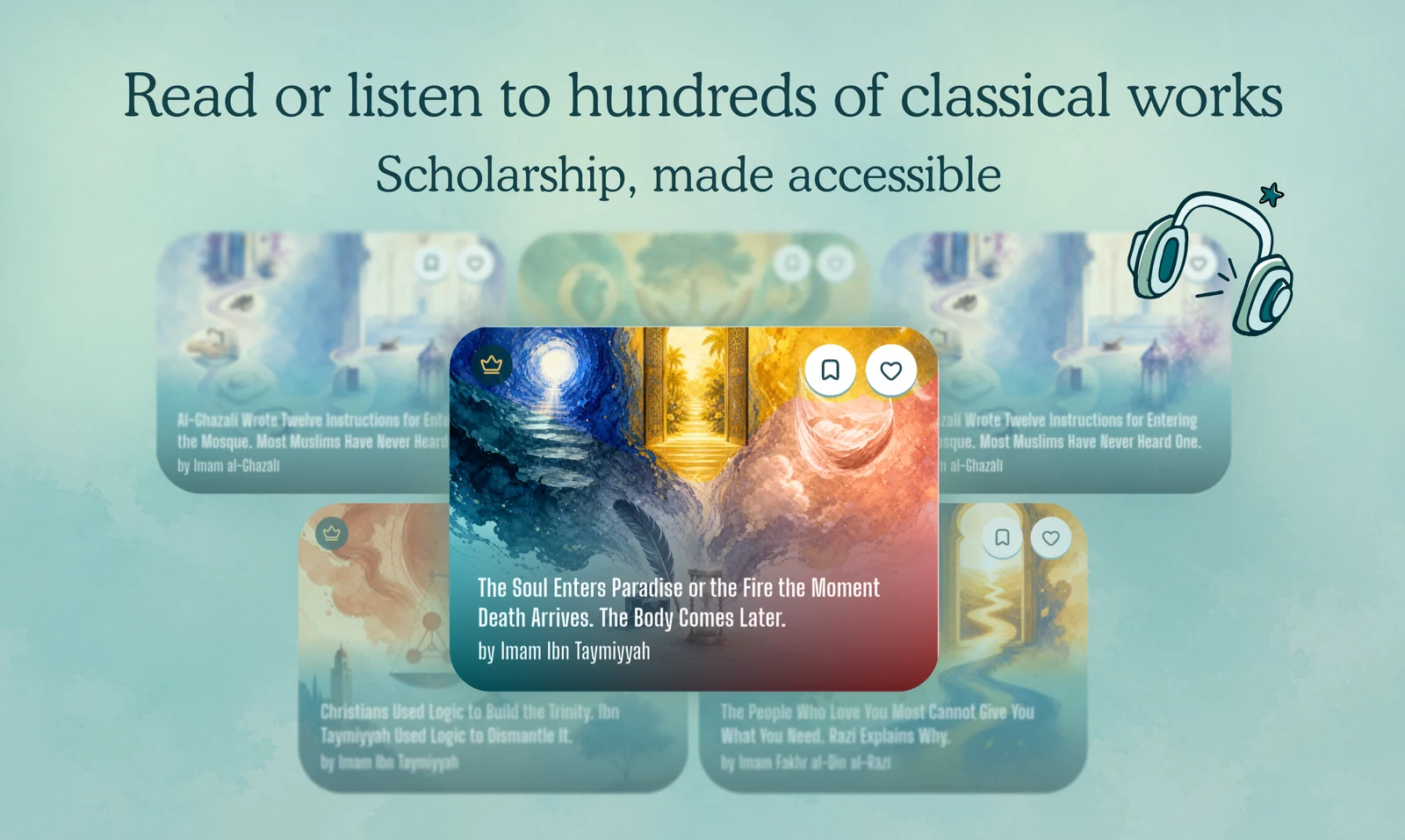
Every insight is written to be read or listened to, and organised by what someone is actually going through rather than by discipline: Core Belief, Fate and Choice, Comeback Path, Dealing with Doubt.
The frameworks are visible in the output. Not “an overview of the soul in Islamic thought”, but “The Soul Enters Paradise or the Fire the Moment Death Arrives. The Body Comes Later.” Not “mosque etiquette”, but “Al-Ghazali Wrote Twelve Instructions for Entering the Mosque. Most Muslims Have Never Heard One.” Not “on human limitation”, but “The People Who Love You Most Cannot Give You What You Need. Razi Explains Why.”
Every one of those is a real position from a real book, cited. The hook does the work the tradition’s own writers did. It makes you need the answer before you get it.
Then we made the four things behave as one thing.
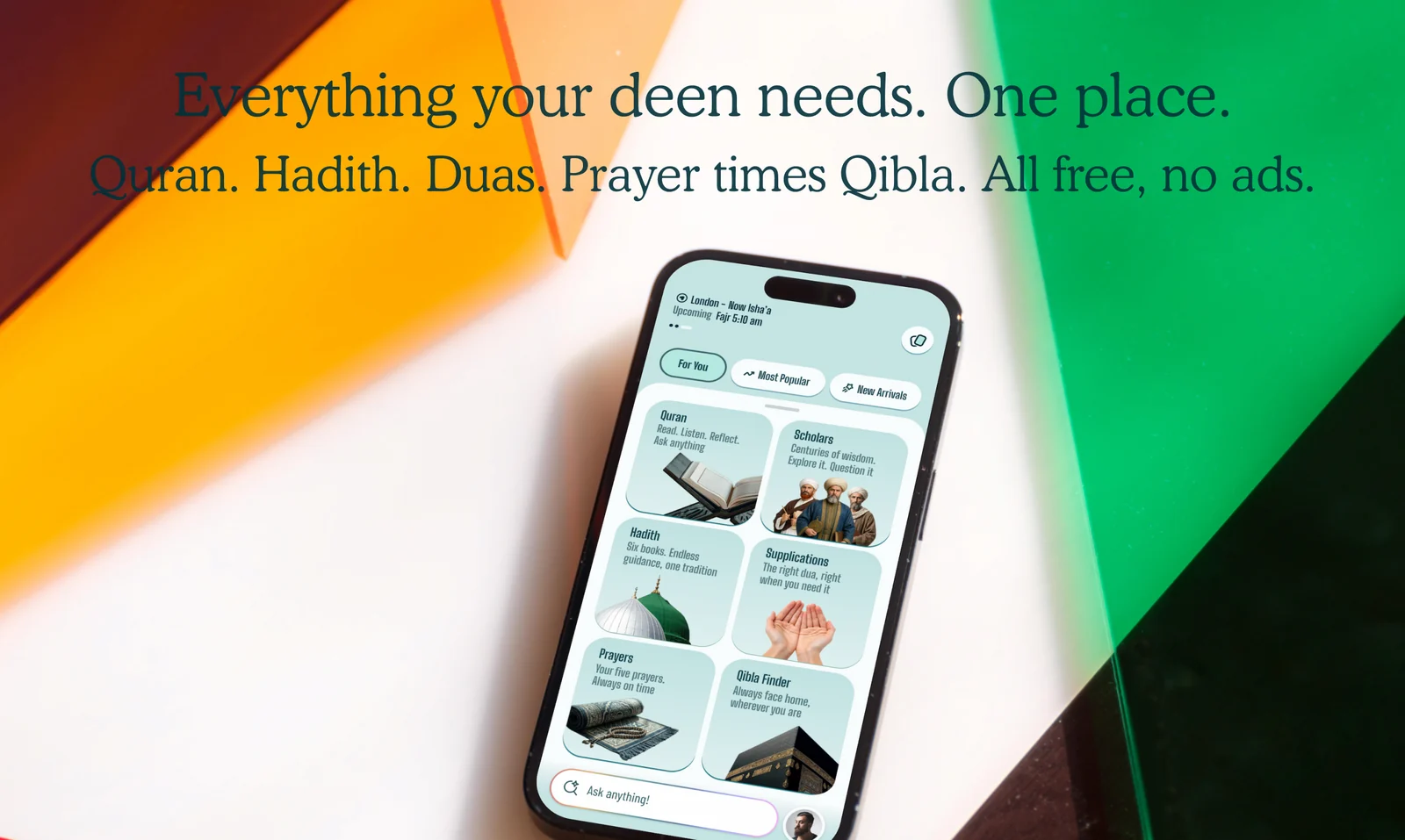
By this point the app held Quran with tafsir, six books of hadith, the scholars’ works, and the insights. Four bodies of knowledge that the tradition never treated as separate, sitting in four separate places on a phone.
So they were wired together. A question can draw across all of them at once. An insight links to the hadith it rests on. A hadith carries its grading, its chain, and the context that stops it being read alone. A verse opens into tafsir and into what scholars made of it.
Where graders disagree, the app does not pick a winner. It shows Sahih by one authority and Da’if by another behind a “Scholars Differ” badge. Harder to build than a single verdict, and far more faithful to classical hadith science.
That is the same principle as everything above it. Ask a contested question and IslamIQ returns what the scholars actually held, across the schools, each position cited to its source. A chatbot’s whole instinct is to resolve. Resolving here would mean a machine performing ijtihad, flattening fourteen centuries into one confident paragraph.
Finally, the ordinary things, done properly.
Prayer times, qibla, duas and adhkar. Every Islamic app has them, which was the reason to look harder at what everyone had settled for.
Research in the places Muslims actually complain, on Reddit, Quora and app reviews, surfaced a problem no app had touched. People keep personal duas in notebooks, in notes apps, in messages to themselves. An entire physical journal industry exists around it. Then they make the dua, move on, and never connect the dots when it is answered. The gratitude loop breaks.
A private archive of what you asked for and what came back. That is not gamification. It is tawakkul made visible.
Dua Vault lets someone write their own supplication in their own words and mark it answered when it is. Then, because the retrieval system already existed, it does the thing only this app could. Seek from the Sunnah finds the authenticated masnoon duas that ask for the same thing.
Even the wording was argued over rather than assumed. Qabool was rejected as theologically loaded, tawassul for carrying scholarly disagreement, du’a al-ma’thur for being too specialist. Masnoon was precise and understood.
Quran, hadith, duas, prayer times and qibla are free permanently, with no advertising. The parts of the deen nobody should have to pay to reach are not the business model.
Running underneath all of it: restraint.
Some questions should not be answered by software at all. Three layers handle that, and none are visible to someone using the app well.
Before retrieval, a hard block on categories where a generated answer could cause real harm. These match on the query itself and serve a static response with routing to human help. No model call, no chance of improvisation.
After generation, a scan for the language of ruling. If the model has drifted into “it is obligatory upon you”, it is stripped and replaced with a disclaimer and a redirect to a qualified scholar.
For contested territory, a classifier detects sectarian and madhab signals before the model runs, and injects a neutrality instruction: present all major positions fairly, none as definitive Islam.
When we don’t know something with certainty, we clearly say so rather than fabricate an answer.
From the product’s own FAQ, and the rule the architecture exists to keepAbove all three sits one rule about cost. If the system is unsure which category a question falls into, it under-answers. A slightly frustrated user is a small cost. Someone making a life decision on a generated answer is not. The asymmetry isn’t close, so the default isn’t either.
Live, and not finished.
IslamIQ is on Google Play and in review for iOS. It is the only work on this site that is entirely ours: strategy, research, design, content and the AI architecture underneath, all in-house.
Which also means there is no client to hide behind. Every restraint above cost a feature, a faster answer, or a cleaner demo. We would make the same calls again.
Two small things say the most about how it is run. Every testimonial on the website is labelled early access tester, because they are, and inventing social proof for a product about religious knowledge would poison it at the root. And when we found mid-build that our AI provider routed data through servers outside the regions our privacy policy claimed, we rewrote the policy rather than keep a convenient sentence.
The hardest engineering on this product went into the answers it declines to give.